
“Wait…white tea, green tea, oolong, and black tea all come from the same plant?”
It’s one of the biggest surprises people discover when they begin learning about tea.
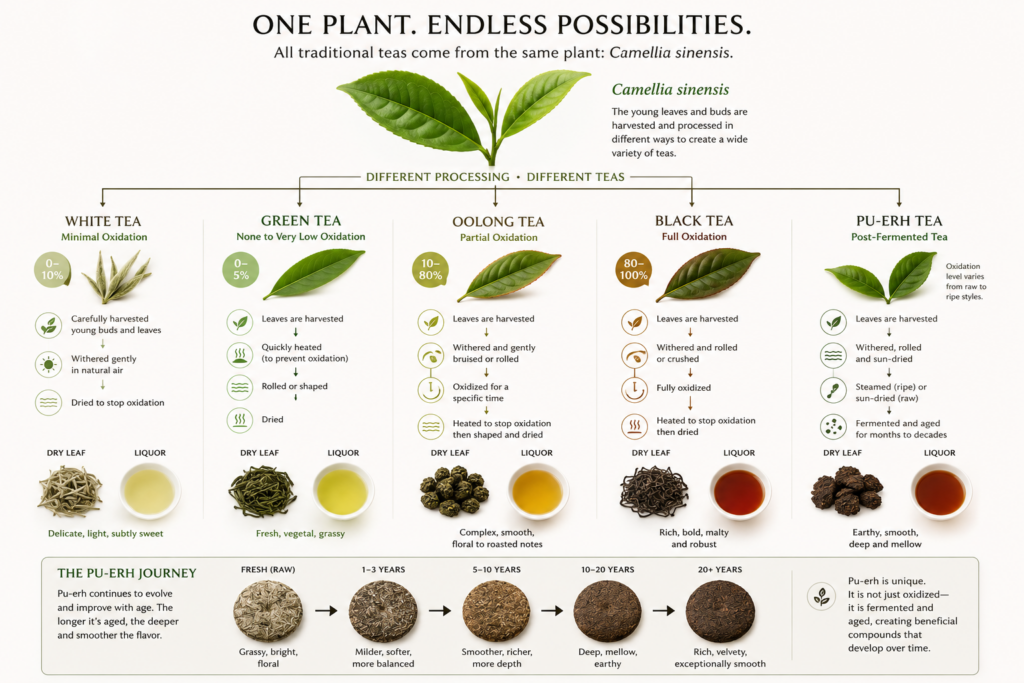
Many assume each tea comes from a different species of plant. In reality, nearly every traditional tea enjoyed around the world comes from one remarkable evergreen shrub:
Camellia sinensis.
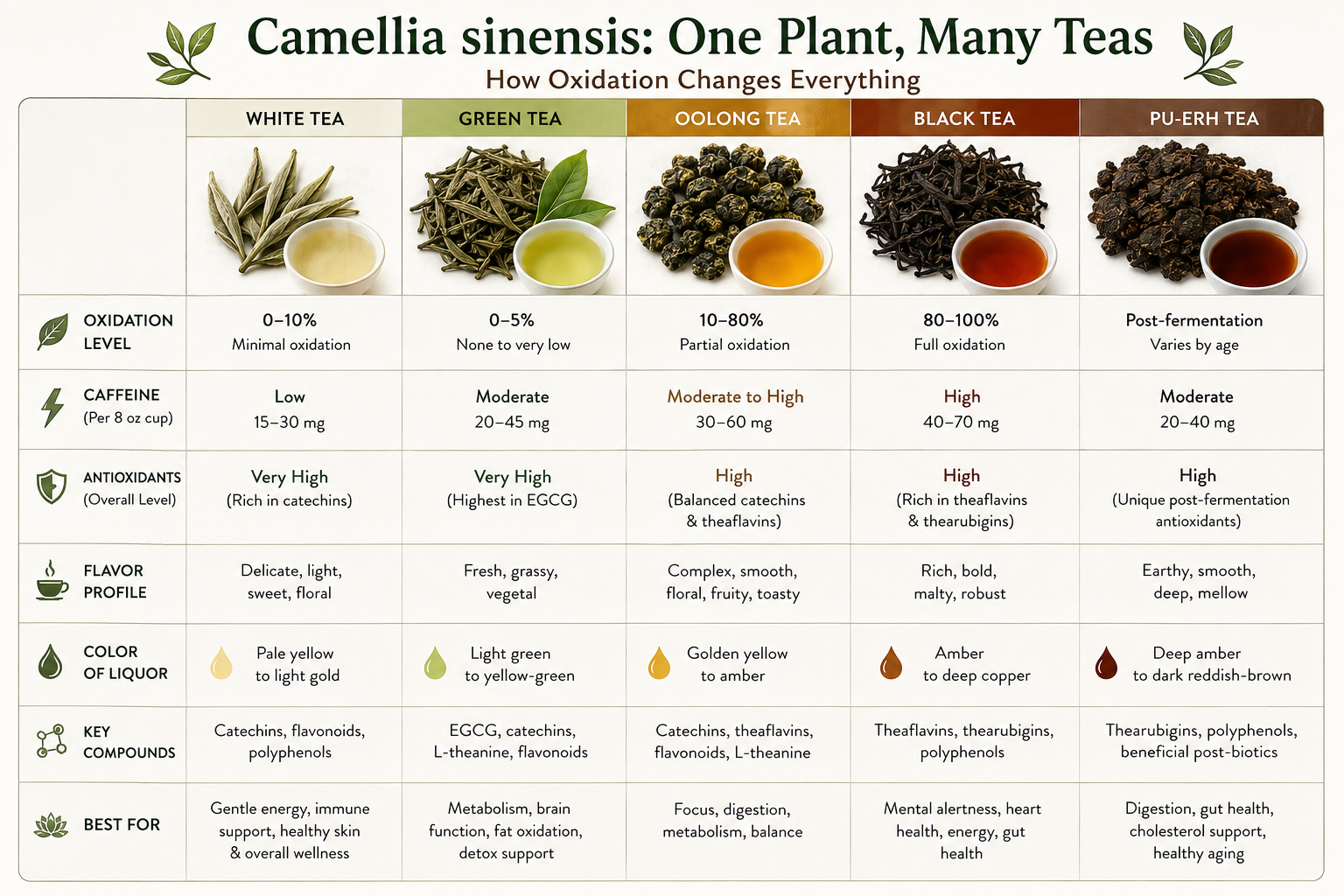
From delicate white tea to rich black tea, these varieties are all members of the same family. Their differences aren’t because they’re different plants—they’re created by when the leaves are harvested and how much they’re allowed to oxidize after picking.
That single decision changes everything.
Flavor.
Color.
Caffeine.
Antioxidants.
Chemical composition.
Nature has essentially given us one plant capable of producing dozens of unique beverages, each offering its own collection of health-supporting compounds.
It All Begins With One Leaf
Imagine picking an apple.
Pick it when it’s tiny and immature—it tastes different than one picked fully ripe.
Tea works much the same way.
Some teas are made from the youngest unopened buds.
Others include young leaves.
Some are gently dried immediately after harvesting.
Others are rolled, bruised, fermented, aged, or allowed to fully oxidize.
The result?
Five primary categories of traditional tea:
- White Tea
- Green Tea
- Oolong Tea
- Black Tea
- Pu-erh Tea
Each offers its own unique chemistry and health benefits.
White Tea
The Least Processed
White tea is harvested early in the season, often using only the unopened buds covered in tiny white hairs.
After harvest, the leaves are simply withered and dried.
Very little oxidation occurs.
This preserves many of the plant’s delicate polyphenols and catechins.
Potential Benefits
• Exceptionally high antioxidant content
• Supports healthy aging
• Helps protect cells from oxidative stress
• Gentle source of natural caffeine
• Supports healthy skin
• May help maintain healthy blood pressure
• Mild support for immune function
Because it undergoes minimal processing, white tea often contains some of the highest concentrations of protective plant compounds.
Green Tea
Nature’s Antioxidant Powerhouse
Green tea is quickly heated after harvest to prevent oxidation.
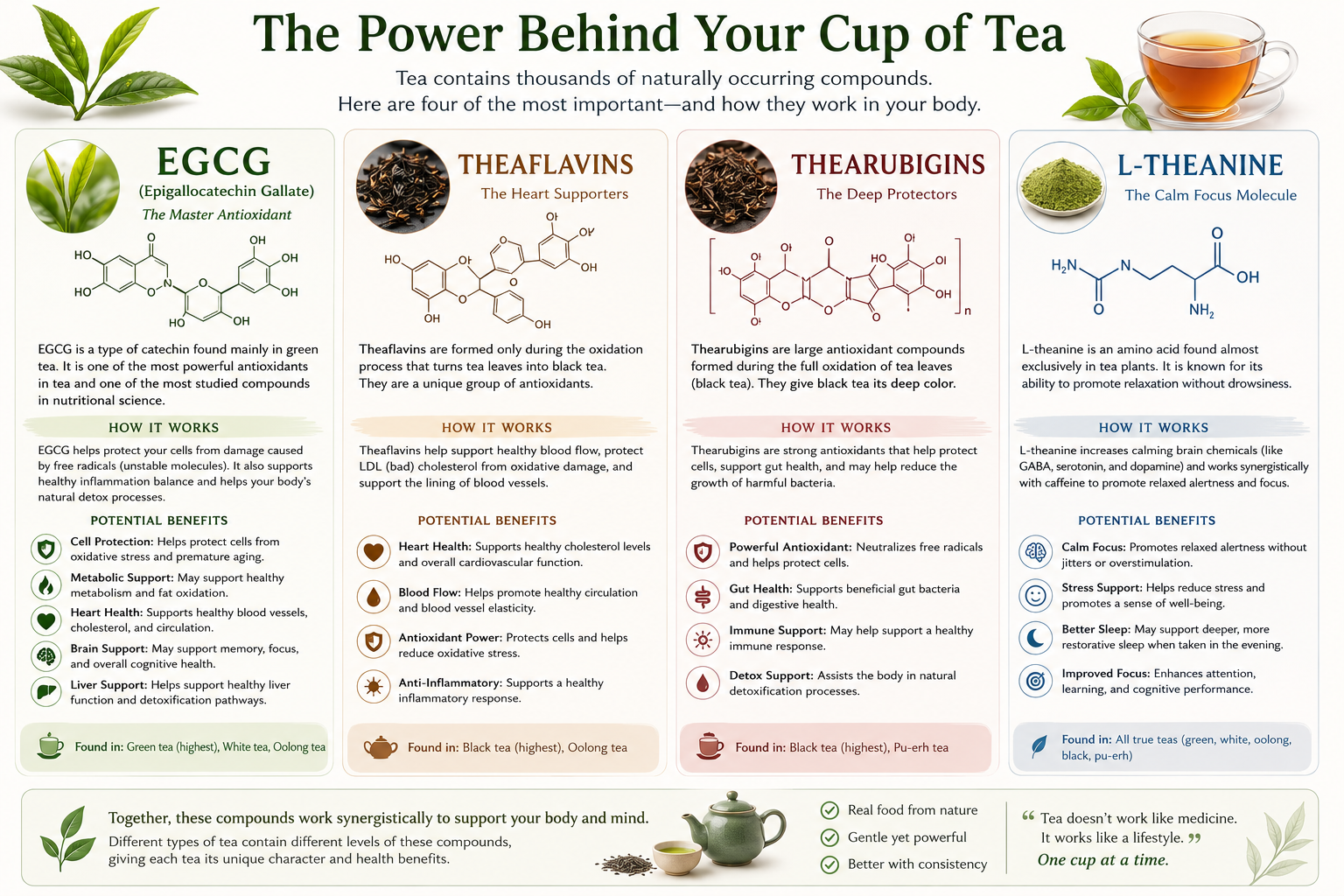
This preserves large amounts of EGCG (epigallocatechin gallate)—one of the most studied plant compounds in nutritional science.
Thousands of scientific studies have examined green tea’s effects.
Potential Benefits
• Supports cardiovascular health
• Supports healthy blood sugar metabolism
• Helps maintain healthy cholesterol
• Supports healthy weight management
• Promotes healthy inflammatory balance
• Supports cognitive function
• May enhance fat oxidation during exercise
• Supports healthy liver function
• Provides antioxidant protection throughout the body
Many researchers consider green tea one of the healthiest beverages available.
Oolong Tea
The Perfect Balance
Oolong falls between green and black tea.
It is partially oxidized.
Depending on the style, oxidation may range anywhere from 10% to nearly 80%.
This creates an incredible diversity of flavors—from floral and buttery to rich and roasted.
Potential Benefits
• Supports metabolism
• Promotes healthy digestion
• May support balanced blood sugar
• Supports cardiovascular wellness
• Encourages healthy gut bacteria
• Natural mental alertness without excessive stimulation
Many tea drinkers describe oolong as offering the “best of both worlds.”
Black Tea
Fully Oxidized, Deeply Nourishing
Black tea undergoes full oxidation.
During this process, many catechins transform into compounds known as theaflavins and thearubigins.
These unique antioxidants provide many of black tea’s health-supporting properties.
Potential Benefits
• Supports heart health
• Supports healthy circulation
• Helps maintain healthy cholesterol
• Promotes healthy blood vessel function
• Supports focus and concentration
• Provides sustained energy
• Supports a healthy gut microbiome
• Rich source of antioxidants
For many people, black tea provides steady energy without the rapid highs and crashes commonly associated with sugary energy drinks.
Pu-erh Tea
The Living Tea
Pu-erh is unlike any other tea.
After processing, it continues to age through microbial fermentation.
Some Pu-erh teas are only a few years old.
Others have been aging for decades.
This fermentation changes both the flavor and the microbial compounds within the tea.
Potential Benefits
• Supports digestion
• Encourages microbial diversity within the gut
• Supports healthy cholesterol
• May aid fat metabolism
• Supports liver health
• Promotes healthy aging
• Rich in unique post-fermentation compounds
Many tea lovers describe Pu-erh as the wine of the tea world.
Tea Doesn’t Work Like Medicine
One of the biggest misconceptions about tea is expecting dramatic overnight changes.
Tea doesn’t usually work that way.
Tea is a lifestyle.
Think of brushing your teeth.
You don’t brush once and expect perfect dental health.
You brush every day because the small daily habit creates enormous benefits over time.
Tea works remarkably similarly.
Why Consistency Matters
Every cup of tea delivers hundreds of naturally occurring plant compounds.
These include:
- Polyphenols
- Catechins
- Flavonoids
- Amino acids
- Minerals
- Antioxidants
These compounds don’t “fix” the body overnight.
Instead, they gently support normal biological processes day after day.
That consistency matters.
What Happens When You Drink Tea Daily?
People who regularly replace sugary beverages with tea often notice gradual changes over time.
These may include:
- Better hydration
- More consistent energy
- Improved concentration
- Less afternoon fatigue
- Fewer sugar cravings
- Better digestion
- Improved bowel regularity
- Healthier skin
- Better sleep when evening herbal teas replace caffeinated drinks
- Reduced dependence on high-sugar beverages
Many of these benefits occur not only because of what tea contains—but because of what it replaces.
Tea vs. Soda
Consider the average soft drink.
Many contain:
- 35–50 grams of added sugar
- Artificial colors
- Artificial flavors
- Phosphoric acid
- High-fructose corn syrup (in many formulations)
- Little to no nutritional value
Drinking several sodas daily may contribute to excessive calorie intake, poor dental health, blood sugar spikes, and increased risk of chronic diseases over time.
Tea, on the other hand, contains virtually no calories when consumed plain and delivers beneficial plant compounds instead of added sugar.
Replacing even one sugary beverage each day with tea can significantly reduce yearly sugar intake.
Replacing several can have an even greater impact.
Tea vs. Energy Drinks
Energy drinks often rely on combinations of:
- High doses of caffeine
- Sugar
- Artificial sweeteners
- Synthetic stimulants
While they may provide a temporary burst of energy, many people experience the familiar crash that follows.
Tea provides a different experience.
The combination of moderate caffeine and the amino acid L-theanine promotes calm alertness rather than overstimulation.
Many tea drinkers describe feeling focused without feeling jittery.
Your Gut Loves Tea
Your digestive tract houses trillions of bacteria that influence far more than digestion.
The gut communicates with the immune system, brain, hormones, metabolism, and even mood.
Tea polyphenols help nourish beneficial bacteria while encouraging a healthier microbial balance.
A healthier microbiome may influence:
- Immune resilience
- Inflammation
- Digestive comfort
- Mood
- Nutrient absorption
- Metabolic health
Scientists continue discovering new ways tea interacts with the gut microbiome.
Tea and the Brain
Tea has long been associated with mental clarity.
Modern research suggests several reasons why.
L-theanine helps promote relaxed alertness.
Moderate caffeine supports attention and reaction time.
Antioxidants may help protect neurons from oxidative damage.
Together, these compounds may support:
- Focus
- Memory
- Learning
- Cognitive performance
- Healthy brain aging
Tea and the Immune System
Tea doesn’t “boost” the immune system in the way advertisements often claim.
Instead, research suggests tea’s polyphenols may help support normal immune function by reducing oxidative stress, supporting a healthy inflammatory response, and promoting a balanced gut microbiome—an important partner of the immune system.
A resilient immune system depends on many factors, including sleep, nutrition, movement, stress management, and overall dietary patterns. Tea can be one helpful part of that larger picture.
Tea and Healthy Detoxification
Your body already has an extraordinary detoxification system.
Your liver, kidneys, digestive tract, lungs, and skin work around the clock to process and eliminate waste products.
Tea doesn’t replace these systems or “flush toxins” in the dramatic way some marketing claims suggest.
What tea may do is help support the body’s natural detoxification processes by providing antioxidants, encouraging hydration, and supplying plant compounds that help protect cells from oxidative stress. Some research also suggests certain tea compounds may support normal liver function, which plays a central role in the body’s detoxification pathways.
In other words, tea helps support the organs that already do the work.
What About Five Years From Now?
Perhaps the greatest benefit of tea isn’t found in a single cup.
It’s found in the next 1,825 cups.
When someone chooses tea day after day, year after year, they are repeatedly giving their body hydration and beneficial plant compounds while often replacing beverages high in added sugars or artificial ingredients.
Over the course of five years, those small choices can add up to:
- Thousands of cups rich in antioxidants.
- Significantly less added sugar if tea replaces soda or energy drinks.
- Ongoing support for heart, brain, gut, and metabolic health.
- A calming daily ritual that encourages mindfulness and stress reduction.
- Better long-term hydration habits.
No single cup changes your life.
But thousands of cups just might help shape a healthier one.
A Cup Worth Savoring
Tea has been cherished for thousands of years—not because it promises miracles, but because generation after generation recognized something special in this simple leaf.
One plant.
Hundreds of beneficial compounds.
Countless traditions.
Whether you enjoy the delicate sweetness of white tea, the fresh vibrancy of green tea, the complexity of oolong, the earthy depth of Pu-erh, or the comforting richness of black tea, you’re participating in a tradition that has nourished cultures around the world for centuries.
At Tea of Life Apothecary, we believe wellness is rarely built by dramatic overnight changes. More often, it’s built by small, consistent choices made day after day.
Sometimes, one of those choices can begin with something as simple—and as remarkable—as a cup of tea.