
Before there was a pharmacy on every corner, there was a kitchen.
There was a garden and a grandmother who knew which plant to steep when your stomach hurt, what to put on irritated skin, what to make when someone couldn’t stop coughing, and what foods seemed to settle a sick stomach.
Long before we had laboratories capable of identifying phytochemicals, receptors, enzymes, inflammatory pathways, or active constituents, human beings were observing something much simpler: What happens when I do this? They watched, experimented, they remembered, and then they taught someone else. That is one of the foundations of what we now call natural remedies.
And somewhere along the way, we began acting as though all of that knowledge was foolish simply because the people who discovered it couldn’t explain the biochemistry behind it. I think it’s time we have a more honest conversation about that.
What Is a Natural Remedy?
A natural remedy is generally a health-supporting practice using substances or methods found in nature rather than relying exclusively on manufactured pharmaceutical interventions. That can include:
- medicinal herbs
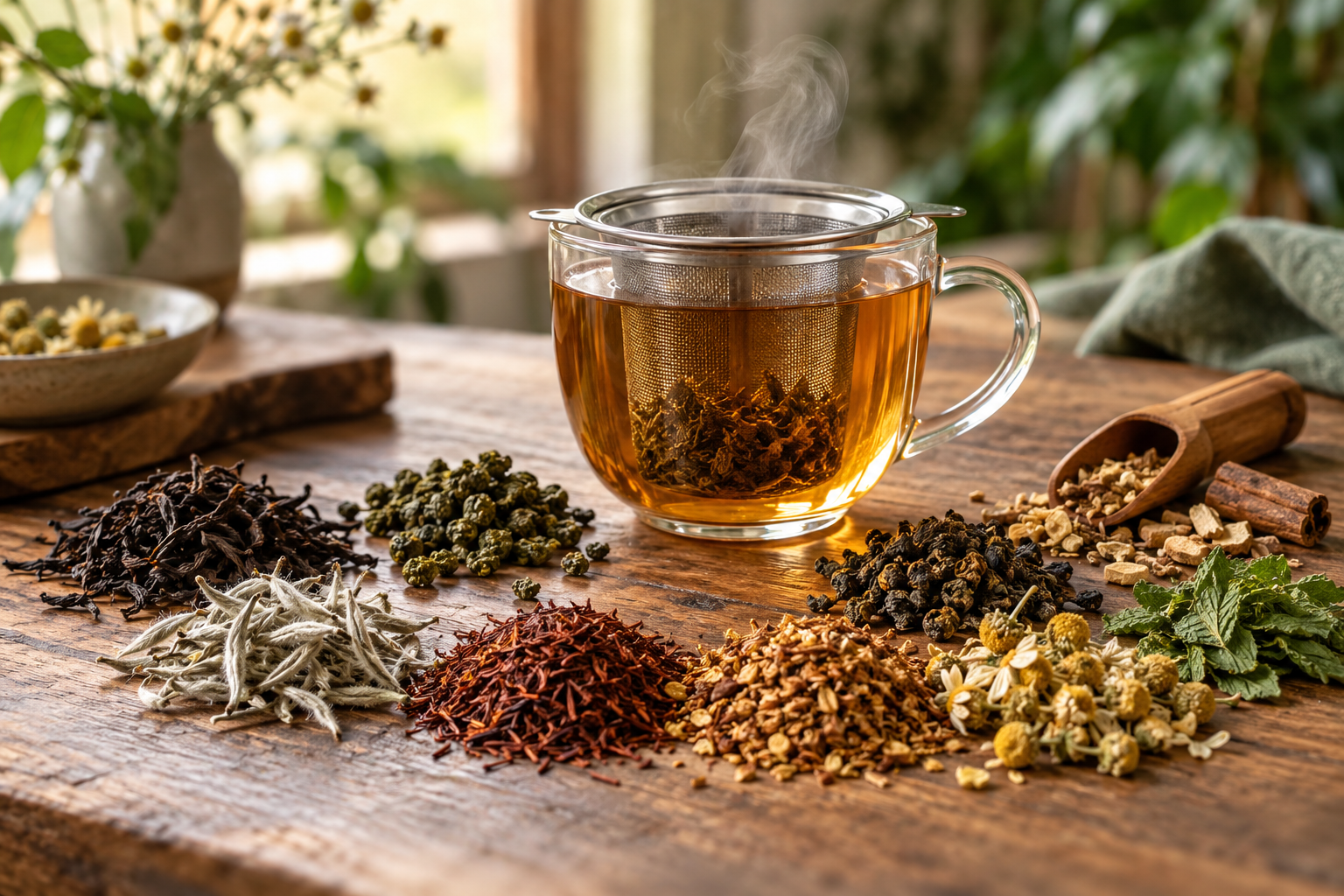
- teas and infusions
- honey
- foods and spices
- compresses and poultices
- mineral preparations
- saline rinses
- oils and topical preparations
- heat and cold
- hydration, rest and nourishment
Natural medicine didn’t begin as a movement against conventional medicine. It existed because, for most of human history, it WAS medicine. People learned about plants through observation and repeated experience. Some plants made people feel better. Some did nothing. Others made people violently ill—or killed them.
Over generations, cultures developed increasingly sophisticated systems of traditional medicine. India developed Ayurveda. China developed what became Traditional Chinese Medicine. Indigenous cultures throughout the Americas accumulated enormous knowledge about local plants. European, Middle Eastern and African cultures developed their own traditions of herbal medicine.
Some of this knowledge was eventually written down. Much of it was passed orally from healer to apprentice, parent to child, and grandmother to granddaughter. Plants and botanical medicines have been used since humanity’s earliest history, and plant-derived substances eventually became important building blocks of modern pharmacology.
So Why Did Natural Remedies Become “Alternative”?
This is where the conversation becomes complicated. As medicine advanced, we gained something extraordinarily valuable: the ability to test things systematically. We learned how to isolate compounds, calculate doses, understand anatomy and physiology, identify pathogens, perform surgery safely, develop antibiotics, create vaccines, treat trauma and determine whether a treatment actually performed better than placebo.
Those advances have saved an extraordinary number of lives, but something else happened too. Medicine increasingly moved away from household and community knowledge and toward standardized, professionally administered treatment. Traditional remedies presented a problem for the emerging scientific model.
Plants aren’t always standardized.
One chamomile plant may contain different concentrations of constituents than another. Soil matters. Harvest time matters. Storage matters. Preparation matters. Dose matters. traditional medicine frequently asks a different question from pharmaceutical research.
Traditional knowledge often begins with: “People have repeatedly observed this helping with this problem.” Modern research asks: “Can we isolate, standardize and reproduce that effect under controlled conditions?”
Those are not the same question. And when modern science hasn’t adequately answered the second question, it has made the mistake of assuming the first observation must therefore be meaningless. It isn’t. Traditional use is evidence of human experience. It simply isn’t the same level or type of evidence as a controlled clinical trial.
“There Is No Evidence” Can Be a Misleading Phrase
You’ll often hear science-based entities say: “There’s no evidence that natural remedy works.” What does that actually mean?
Sometimes it means researchers studied something extensively and found that it didn’t work, other times it means the research produced conflicting results, or the studies were simply too small to reach a conclusion. Sometimes it means we haven’t adequately studied it yet. Those are four VERY different situations.
Absence of good evidence should make us cautious about claiming that something works, BUT it should not automatically be transformed into proof that something doesn’t work.
Traditional knowledge can give researchers a starting point. Science can then help us determine whether an observed effect is real, why it happens, what dose is appropriate, who should avoid it and what risks or interactions might exist. Those approaches don’t have to be enemies, in fact, that’s where things get fascinating.
Science Has Already Validated Some Very Old Ideas
Peppermint has been used traditionally for digestive discomfort for generations.
Modern research has investigated it, and the National Center for Complementary and Integrative Health reports evidence that enteric-coated peppermint oil may help relieve some symptoms of irritable bowel syndrome, including abdominal discomfort, bloating and gas.
Ginger has an extensive history as both food and traditional medicine, particularly for digestive complaints, and it has subsequently been investigated in clinical trials for gastrointestinal conditions.
Saline nasal irrigation is another fascinating example. Nasal rinsing has roots in the Ayurvedic tradition, yet today saline irrigation is hardly viewed as some bizarre fringe practice. It is widely recognized as a non-drug approach to clearing the nasal passages, although evidence for treating the common cold specifically remains limited.
That’s why I don’t particularly like the battle between “natural” and “conventional.” The better question is: Does it work? Followed by: Is it safe? And then: Is it appropriate for this particular person and situation? Remedies don’t become ineffective simply because our ancestors discovered it first. Additionally, they don’t become safe simply because it grows in the ground. We need both wisdom and discernment.
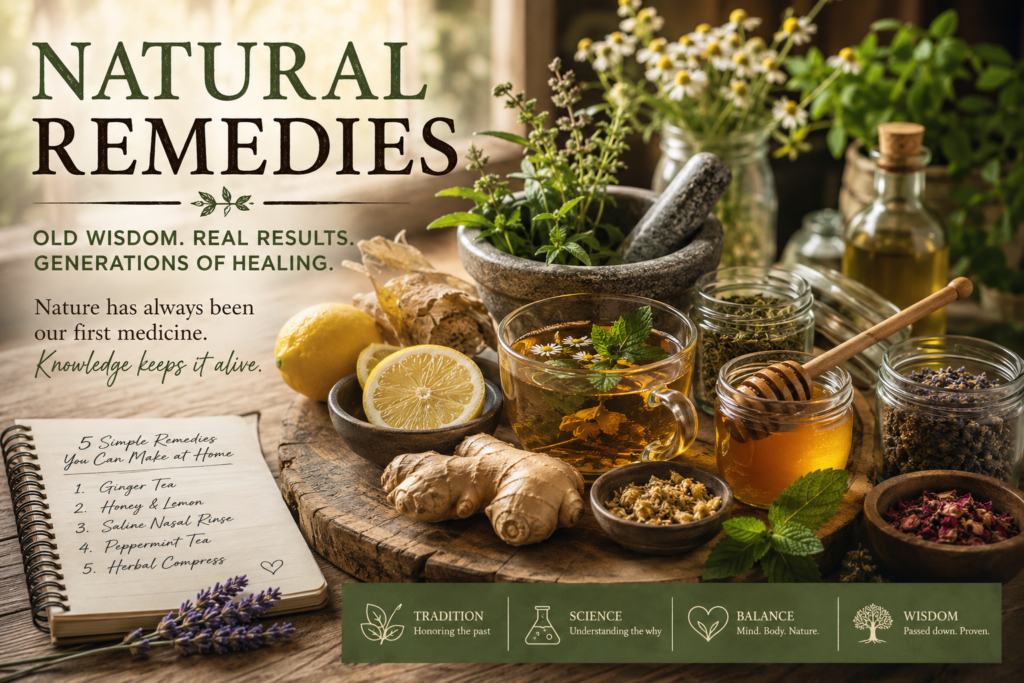
Five Simple Natural Remedies Worth Knowing
These aren’t miracle cures. They’re practical tools that illustrate something humans have understood for a very long time: Sometimes the body needs support—not necessarily a complicated intervention.
1. Ginger Tea for an Upset Stomach
Ginger may be one of the easiest traditional remedies to keep in your kitchen.
Make it:
Thinly slice approximately 1 inch of fresh ginger root.
Add it to about 2 cups of water.
Gently simmer for approximately 10–15 minutes.
Strain and sip slowly.
A little honey or lemon can be added if desired.
Ginger has been extensively studied for nausea and gastrointestinal effects, although effectiveness depends upon the specific condition and preparation.
Traditional wisdom met modern investigation—and ginger didn’t disappear.
2. Honey & Lemon for a Scratchy Throat or Cough
This might be one of Grandma’s most recognizable remedies.
Add approximately:
- 1 tablespoon honey
- a squeeze of fresh lemon
- 8 ounces warm water
Sip slowly.
The warmth provides comfort and hydration while honey coats the throat. Research into honey for cough has produced promising but not perfectly uniform results, which is exactly why responsible natural medicine shouldn’t exaggerate what we know.
Important: Honey should never be given to a child younger than 12 months because of the risk of infant botulism.
3. Saline Nasal Rinse for Congestion
Sometimes the simplest remedy isn’t an herb at all.
Saline irrigation can physically flush mucus, allergens and debris from the nasal passages. Commercial saline packets are the easiest option, but the important safety rule is this: Never use ordinary tap water for nasal irrigation. Use distilled, sterile, or appropriately boiled-and-cooled water and properly clean the device.
NCCIH notes that saline irrigation may be used for congestion, allergies and colds, although research regarding cold symptom relief remains limited.
4. Peppermint for Digestive Comfort
Peppermint has traditionally been associated with digestion, gas and abdominal discomfort. For a simple home preparation, peppermint leaves can be steeped as tea: Add roughly 1–2 teaspoons dried peppermint leaf to 8 ounces of hot water. Steep approximately 5–10 minutes, strain and enjoy.
Here’s where an important distinction matters: much of the stronger clinical research for IBS involves enteric-coated peppermint oil capsules, not ordinary peppermint tea. We shouldn’t pretend those preparations are interchangeable. The interesting part is that modern investigation has identified physiologic effects of peppermint oil—including antispasmodic activity—that may help explain why peppermint developed its centuries-old digestive reputation in the first place. Sometimes science doesn’t destroy traditional knowledge it helps explain it.
5. A Warm Herbal Compress
One of the oldest forms of home care may also be one of the most overlooked: warmth.
For everyday muscle tension or minor aches, prepare a strong infusion of an aromatic herb such as chamomile or lavender, allow it to cool enough to safely touch, soak a clean cloth in the liquid, wring it out and apply it comfortably warm to the area.
However, let’s separate the components, warmth itself may be soothing. The aroma may encourage relaxation. The ritual forces us to sit still for ten minutes.
Whether a particular herb significantly adds to the physiologic effect depends upon the herb, preparation and condition—and many traditional topical preparations simply haven’t been adequately studied.
Grandma Didn’t Have a Laboratory
This may be my favorite part of this entire conversation, imagine living 300 years ago. You don’t know what a prostaglandin is or what an inflammatory cytokine is. You have never heard the words antispasmodic, antimicrobial, phytochemical or bioactive compound but you notice something.
Every time someone in the family has an upset stomach, Grandma makes a particular tea and frequently they feel better. So her daughter remembers, her granddaughter remembers, her great-granddaughter remembers.
Eventually someone writes it down.
Generations later, scientists put that plant into a laboratory, identify its chemical constituents and begin investigating what those compounds actually do inside the human body. Did the plant suddenly start working the day the laboratory discovered the mechanism? Of course not. The science didn’t create the plant’s chemistry it gave us a way to measure, challenge and better understand it. THAT is where I believe conventional and natural medicine should meet.
Natural Does Not Mean Harmless
There is another side of this conversation that anyone advocating for natural remedies has a responsibility to discuss.
Poison ivy is natural – Hemlock is natural – Tobacco is natural.
Many powerful medications originated from natural substances so “natural” should never automatically mean safe. Herbs can cause allergic reactions, they can interact with medications, affect blood pressure, blood sugar and blood clotting. Some aren’t appropriate during pregnancy or breastfeeding others can be dangerous with certain medical conditions. A home remedy should never delay emergency medical care for something potentially serious. Natural medicine deserves respect.
And respecting it means respecting its power enough to use it responsibly.
Maybe We Have Been Asking the Wrong Question
Perhaps the question shouldn’t be: Natural medicine or conventional medicine? Perhaps it should be: What does this person need right now?
There are times when the issue warrants the herb garden and times when it warrants the kitchen. There are times when rest, hydration, nourishment and time will suffice. And there are absolutely times when I want the emergency department, diagnostic imaging, antibiotics, surgery, pharmaceuticals and every extraordinary advancement modern medicine has given us.
We don’t have to erase thousands of years of human observation in order to appreciate modern medicine or reject modern medicine in order to acknowledge that our ancestors knew some things worth remembering.
The World Health Organization itself recognizes that traditional medicine has a long history and has contributed to conventional medicine. Perhaps that’s the conversation we should be having.
Not: “Which side are you on?” But: “What have generations of human beings observed—and what can modern science help us understand about it?” Because natural remedies aren’t automatically effective, safe or replacements for every medication or medical intervention. They aren’t automatically nonsense, either.
Some have been disproven, some remain uncertain, and some are only beginning to be investigated.
Science FINALLY discovered that Grandma may have been onto something all along.
This article is intended for educational purposes only and is not intended to diagnose, treat, cure or prevent disease or replace individualized medical care. Herbs and natural products can interact with medications and medical conditions. Seek appropriate medical care for persistent, severe or concerning symptoms.