

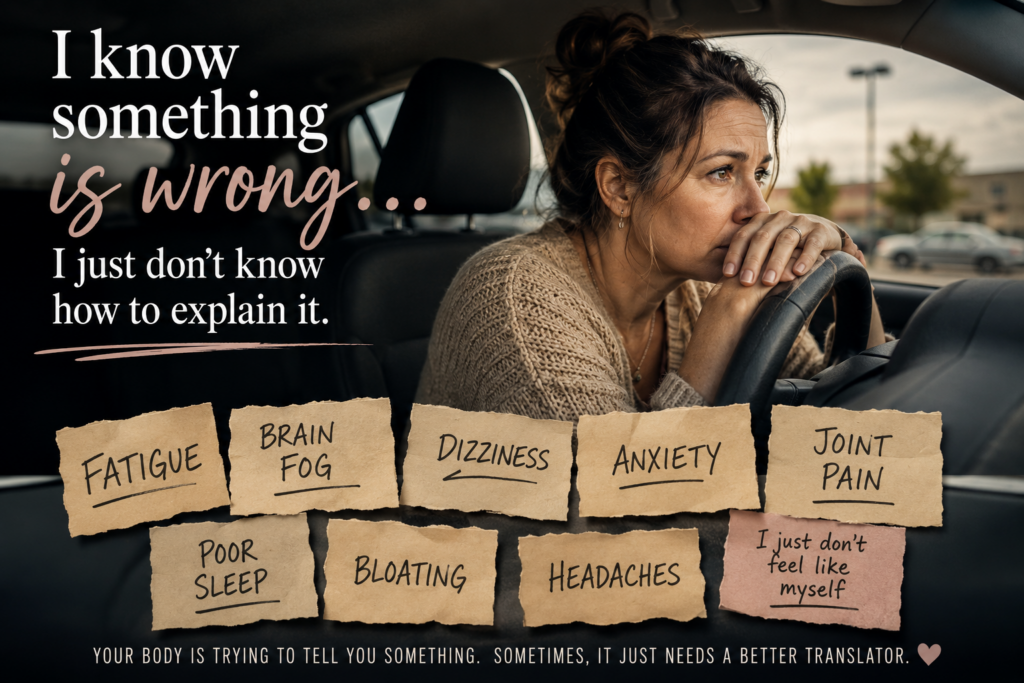
Sometimes the Problem Isn’t That No One Is Listening. Sometimes We Don’t Have the Words to Explain What Our Body Is Saying.
For nearly 30 years as a nurse, I have watched people get stuck in the same exhausting cycle. They don’t feel well, so they make an appointment with their doctor. Blood work is ordered. Maybe they have an X-ray, a CT scan, or an MRI. They go back for their follow-up appointment and are told everything looks pretty normal.
But they don’t feel normal.
So they try again. Maybe they see another doctor, then a specialist, and sometimes another specialist after that. They repeat their story over and over. More blood work. More appointments. More waiting. More copays. More time away from work. Eventually, many of them begin hearing the same phrases: “Your labs look fine.” “There’s nothing here that explains your symptoms.” “It may just be stress.” Or, “Let’s give it some time and see what happens.”
Somewhere along the way, the patient begins questioning themselves. Maybe I am overreacting. Maybe this is just part of getting older. Maybe everyone feels this tired. Maybe I am just stressed. Maybe I really am anxious. Maybe this is normal and I simply need to learn to live with it.
But somewhere deep inside, they still know something has changed.
I have talked to so many people who can’t explain it any better than that. They look at me and say, “I just don’t feel like myself anymore.”
I believe them.
One of the things I have learned over the years is that the problem is not always that a doctor isn’t listening. Sometimes the doctor is listening very carefully. Sometimes the problem is that medicine has its own language, and most patients have never been taught how to speak it.
Think about that for a minute.
If your car starts making a strange noise and you take it to a mechanic, you may say, “My car is making a weird sound.” The mechanic is immediately going to start asking questions. What kind of sound? Is it squealing, knocking, grinding, or clicking? Does it happen when you first start the car? When you brake? Does it get worse when you turn? Does it only happen at higher speeds? Did it start suddenly, or has it slowly gotten louder?
Why does the mechanic ask all of those questions?
Because “my car is making a weird noise” is real, but it isn’t enough information to tell them where to start looking.
Our bodies are far more complicated than a car, yet many of us walk into a medical appointment and say, “I’m tired,” “My stomach hurts,” “I feel anxious,” or “I just feel bad.”
Again, those symptoms are real. The person is not making them up. But medically, those words can mean a thousand different things.
What does “tired” mean to you? Are you sleepy? Do you feel physically weak? Do your muscles feel heavy? Do you wake up exhausted after sleeping eight hours? Do you feel fairly good in the morning but crash at 2:00 every afternoon? Do you feel like you could fall asleep sitting up, or are you completely drained but unable to actually sleep?
Those are very different experiences.
What does “dizzy” mean? Does the room feel like it is spinning? Do you feel like you might pass out? Does your vision go dark when you stand? Do you feel off balance when you walk? Does it happen after you eat? When you turn your head? Does your heart begin racing at the same time?
Those details matter.
Even the word “anxiety” can mean very different things to different people. One person may lie awake at night worrying about their job, their children, or their finances. Another person may be sitting peacefully on the couch when suddenly their heart begins pounding, their hands shake, and their body feels like it is in danger even though their mind isn’t worried about anything at all.
Both people may walk into an appointment and say, “I have anxiety.”
Are they describing the exact same experience?
Maybe they are. Maybe they aren’t.
This is where I believe so many people get lost in our healthcare system. It isn’t always because the doctor is bad. It isn’t always because the patient is “too complicated.” It isn’t always because nobody cares. Often, it is simply a breakdown in language.
The human body doesn’t speak English. It communicates through changes, sensations, symptoms, and patterns. Pain is communication. Fatigue is communication. Changes in bowel habits are communication. Poor sleep is communication. A racing heart is communication. Brain fog is communication.
That does not mean every symptom is a sign of some terrible disease. It doesn’t mean we should panic every time our body does something unusual, and it certainly doesn’t mean we should diagnose ourselves based on a three-minute video we watched online.
Google IS NOT a physician.
Our symptoms are information. The challenge is learning how to describe that information in a way that is actually useful.
I have had countless conversations with people who tell me, “I just feel off.” My next question is usually, “Tell me what ‘off’ feels like to you.”
That is often when the real conversation begins.
Sometimes they have to stop and think about it because no one has ever asked them to explain it that way before.
“Well, I wake up tired.”
Okay. What happens next?
“I drink coffee and I’m usually okay until lunch.”
Then what?
“About an hour after I eat, I can’t think. My brain feels foggy, and I could literally lay my head on my desk and sleep.”
Now we have more information.
Maybe another person tells me they have stomach problems. What kind of stomach problems? “My stomach just hurts all the time.” Where does it hurt? “Mostly right here under my ribs.” Is it burning, cramping, stabbing, pressure, or aching? “Actually, it’s more like pressure.” When does it happen? “I never really thought about it, but usually after I eat.” Does every meal do it? “No. It seems worse when I eat something heavy.” Do you feel nauseated? “Sometimes.” Does the pain go anywhere else? “Actually, sometimes I feel it in my back.”
Do you see what just happened?
The person’s symptoms did not change during that conversation. Their language changed. The story became clearer.
This is one of the reasons I believe so strongly in teaching people to become better historians of their own bodies.
You live in your body 24 hours a day. Your doctor may have 15 or 20 minutes with you.
That is not a criticism of doctors. It is the reality of our healthcare system. Most providers are seeing patient after patient. They are reviewing medications, looking through lab results, documenting visits, dealing with insurance requirements, answering messages, and trying to make good decisions with the information available to them.
They cannot live inside your body for a week and watch what happens.
You can.
Only YOU know that your headache usually starts around 3:00 in the afternoon. Only YOU know that you feel shaky if you go too long without eating. You know your stomach is worse after certain meals. You know your heart races when you stand in the shower. You know you wake up every night between 2:00 and 4:00 in the morning. You know your joints hurt more two days before your menstrual cycle, or that you feel completely exhausted for two days after an extremely stressful event.
You know these things because you experience them.
But if you don’t recognize those details as important, you may never mention them.
That is where I believe education can completely change a person’s healthcare experience.
One of my greatest goals with Tea of Life Apothecary, and one of the driving purposes behind SA Integrative Health, is to help give people language. I want to help give a voice to the person who has spent years feeling dismissed, unheard, or unseen by the medical system.
Not by teaching people to fight with their doctors. There is NO NEED for a fight.
Not by convincing people that every doctor is wrong.
And certainly not by teaching people to walk into an appointment demanding a specific diagnosis they found on the internet.
That is not empowerment.
I want people to learn how to clearly tell the story of their own body.
There is a huge difference between walking into an appointment and saying, “I’m tired all the time,” and saying, “For the last six months, I wake up exhausted even when I sleep seven or eight hours. I feel somewhat better in the morning, but every day around 2:00 p.m., I become extremely fatigued and have difficulty concentrating. I’ve also noticed my hair is thinning, I’m colder than I used to be, and I’ve gained 15 pounds without significantly changing the way I eat.”
You haven’t diagnosed yourself. You haven’t told the doctor how to do their job. You have simply given them a much better story to work from.
Quality information gives your healthcare provider a better foundation to work with.
This is also one of the reasons I love integrative medicine. Not because I believe conventional medicine is bad. I don’t.
I have been a nurse for nearly three decades. I have seen conventional medicine save lives. I have seen medications give people their lives back. I have seen surgeons do incredible things, and I have watched emergency medicine pull people back from the edge of death. There are things conventional medicine does exceptionally well.
But I also believe there is tremendous value in asking more questions.
Sometimes the question isn’t only, “What disease does this symptom fit?” Sometimes deeper questions need to be asked. What else is happening in this person’s body?
How are they sleeping? What does their digestion look like? When did the symptoms begin? Was there an illness before this started? A major stressor? A medication change? A surgery? A pregnancy? A significant loss? Has their menstrual cycle changed? Are the symptoms constant, or do they come and go? What makes them better? What makes them worse?
Could poor sleep be contributing to how they feel during the day? Could chronic stress be affecting digestion? Could nutritional deficiencies be part of the fatigue picture? Could several body systems be influencing one another?
Those questions don’t replace medical care. They expand the conversation.
I believe healthcare works best when the patient and the provider become partners in the investigation. The provider brings years of education, clinical experience, diagnostic tools, and medical knowledge. The patient brings the history of living inside their own body.
We need both.
Unfortunately, many people have become so discouraged by the time they reach us that they have stopped talking. They have told their story so many times that they no longer believe anyone wants to hear it. Some have been told their symptoms are anxiety. Some have been told their labs are normal. Some have been bounced between specialists, with each specialist understandably focusing on the body system they were trained to treat.
This leaves the patient standing in the middle saying, “But I still don’t feel well.”
I hear you.
More importantly, I want to help you learn how to tell your story in a way that may help your healthcare team hear you more clearly.
Sometimes that means tracking your symptoms or writing down what happens before an episode begins. It may mean paying attention to sleep, meals, bowel habits, menstrual cycles, stress, movement, or heart rate. Sometimes it means walking into an appointment with three clear concerns instead of trying to explain 47 symptoms in ten minutes.
And yes, part of this is YOUR responsibility.
Learn the difference between burning, stabbing, aching, pressure, cramping, throbbing, and tingling. Pay attention to when something happens. Notice what makes it better and what makes it worse. Write it down if you need to.
Learn how to say, “I understand my labs are within the reference range, but I am experiencing a significant change from my normal baseline. What could we consider next?”
That is not being difficult.
That is learning to communicate.
My hope for Tea of Life Apothecary and SA Integrative Health has never been to create a place where people are taught to distrust their doctors.
My hope is to create a bridge.
I want to help people understand their bodies better. I want them to recognize patterns. I want them to know what questions to ask. I want them to walk into a medical appointment prepared instead of overwhelmed. I want the person who has spent years saying, “I just don’t feel right,” to finally have the words to explain what “not right” actually feels like.
Because when you finally learn how to tell the story your body has been trying to tell, the entire conversation can change.
Your symptoms are not a diagnosis. They are information. Your patterns are information. Your history is information. Your experience is information.
And maybe finding the next piece of the puzzle begins with something as simple as finding the words.