
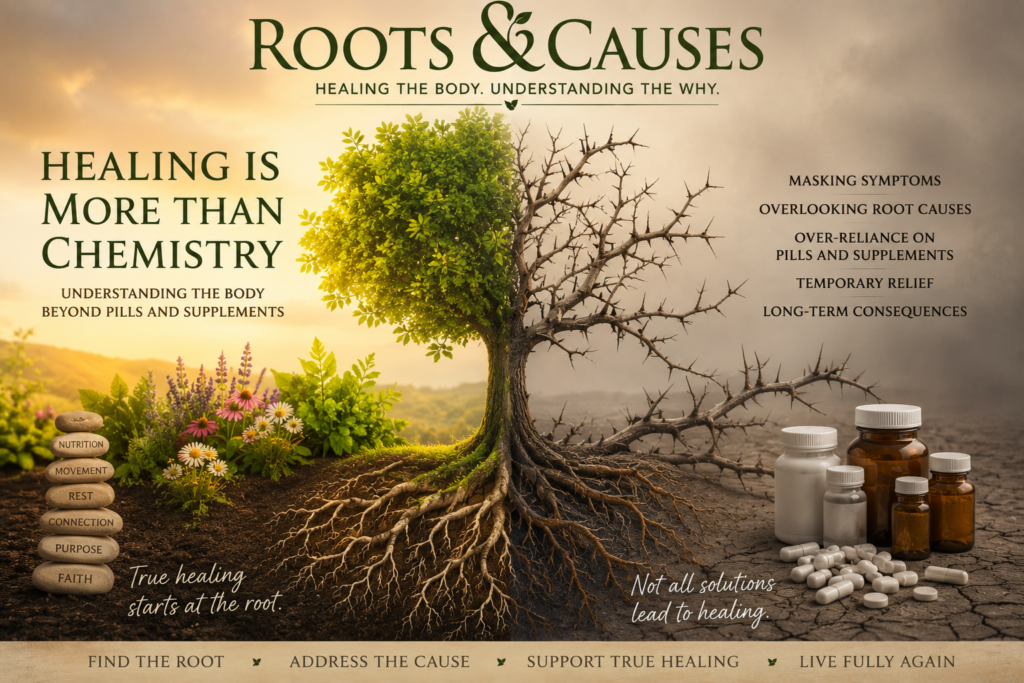
Understanding the Body Beyond Pills and Supplements
“The purpose of the Roots & Causes series is not to replace your healthcare provider or tell you what to think. It is to help you ask better questions, understand your body more deeply, and become an active partner in your health journey. We believe the best healing happens when informed patients and thoughtful healthcare professionals work together.”
Have You Ever Wondered…
Have you ever looked at someone who eats healthy, exercises, takes supplements, drinks plenty of water, and still struggles with pain or chronic health issues?
Maybe that person is you? You may be doing everything “right!” You have changed your diet, started taking vitamins, cut back on sugar, drink more water. You consistently pray for healing, yet something still doesn’t feel right.
If you’ve ever found yourself asking, “What am I missing?” you’re not alone. One of the biggest lessons I’ve learned during nearly 30 years as a nurse is this:
Healing is about much more than chemistry.
Yes, nutrition matters.
Supplements matter.
Medications have an important place.
But the human body is far more amazing — and far more complex — than simply taking the right pill.
God Designed an Amazing Body
As Christians, we believe God created the human body with incredible wisdom and purpose.
Every heartbeat — Every breath — Every nerve — Every muscle — Every cell. They all work together in ways we are still discovering. Striving to understanding how God designed the body doesn’t weaken our faith. It strengthens it. The more we learn about the body, the more we can appreciate the incredible design behind it.
The Body Is an Electrical System
Here’s something many people never stop to think about. When someone’s heart suddenly stops beating…doctors don’t hit them with a stick. They don’t rub dirt on them and hope the heart starts again.
They use electricity. Why?
Because your heart works through electrical signals. Your brain communicates through electrical signals. Your nerves send electrical impulses every second of every day.
Every time you move your arm… Blink your eyes… Take a step… Smile… Or take a breath…
Tiny electrical signals are traveling throughout your body. This isn’t alternative medicine or “woo-woo” new age talk, this is basic human physiology. Your body is both chemical and electrical and BOTH systems matter.
The Body Is Also Mechanical
Let’s add another piece. Imagine the body as a beautifully designed house. Newly wired electricity runs through the walls, water flows through the plumbing, air moves through the vents. If one system isn’t working well, the whole house feels different.
Your body works much the same way. Muscles move bones, fascia connects muscles together, blood carries oxygen, lymph carries away waste, nerves communicate information, and hormones deliver messages. Every system depends on the others. This is why healing is rarely just about fixing one thing.
What Is Fascia?
For years, fascia was thought to be little more than wrapping around muscles. Due to recent discoveries we know it’s much more important.
Fascia is a thin layer of connective tissue that surrounds muscles, organs, nerves, blood vessels, and many other structures. Think of it like the body’s internal web where everything is connected.
If one part becomes tight or restricted, other areas may have to compensate. That’s one reason pain isn’t always felt where the actual problem began. Researchers continue to learn more about fascia and its role in movement, pain, trauma and body awareness.
Why Movement Matters
Your lymphatic system is one of the most overlooked systems in the body. Unlike your heart, which pumps blood every second, your lymphatic system depends on movement.
Walking.
Stretching.
Breathing deeply.
Muscle contractions.
Massage.
These all help move lymphatic fluid through the body. When movement decreases, lymph flow can slow or even become blocked. Early signs of this may include:
- Swelling in the hands or feet
- Socks leaving deep marks around the ankles
- Rings becoming unusually tight
- A feeling of heaviness
- Puffiness that comes and goes
These signs don’t automatically mean something is wrong, but they may be worth discussing with your healthcare provider, especially if they’re new or worsening.
What About Scars?
No one thinks about the impact of scars on healing and body function. Almost everyone has scars. They could be surgical or from an injury. ( C-sections, knee surgery, sports injury, bicycle crash, gardening accident, etc) Even the smallest scar changes tissue.
Scar tissue is different from healthy tissue. It is often less flexible and may change how nearby muscles, fascia, or nerves move.
For some people, scars never cause problems. For others, they may contribute to stiffness, restricted movement, tenderness, or ongoing discomfort. That doesn’t mean the scar itself is “bad but it CAN have an impact on your body.
Why Old Injuries Sometimes Continue to Matter
Have you ever noticed someone say, “I hurt my shoulder twenty years ago, and it still bothers me when the weather changes.” Maybe you’ve experienced something similar.
After an injury, the body naturally protects itself. This protection may result in you changing how you walk, how you stand, it may result in you guarding one side, or favoring one leg. Even after the original injury heals, those movement patterns often remain.
Over time, those changes can place extra stress on muscles and joints in other parts of the body and the original injury isn’t the only issue anymore. The body has adapted for so long that the new pattern has become normal.
Looking Beyond Pills
This is where many supportive therapies may have a role.
Not because they’re magic.
Not because they’re cures.
But because they may help restore movement, improve comfort, and support the body’s natural healing processes and depending on the individual, these might include:
Chiropractic Care
Healthy joints move the way they were designed to move but when joints become restricted, nearby muscles often compensate. Chiropractic care focuses on restoring joint motion and improving overall movement. For many people, this may reduce discomfort and improve function.
Massage Therapy
Massage is much more than relaxation. It can help reduce muscle tension, improve circulation, encourage lymphatic movement, and help restore mobility to tight tissues. Many people notice they sleep better and move more comfortably afterward.
Acupuncture
Acupuncture has been practiced for thousands of years. Modern research suggests it may influence pain pathways, circulation, nervous system activity, and inflammatory responses. Scientists continue to study exactly how these effects occur, but many people find acupuncture to be a valuable part of their care.
Bowen Therapy
Bowen therapy uses gentle, precise movements over muscles and connective tissue. While research is still developing, many people report improvements in relaxation, movement, and comfort following treatment.
Biofeedback
Have you ever wished you could actually see how your body responds to stress? Biofeedback helps people become more aware of certain body functions, such as muscle tension, breathing patterns, or heart rate. For some people, this awareness can become a powerful tool for learning how to better manage stress and improve physical function.
Neural Ozone Therapy
Some integrative practitioners use neural ozone therapy around scars or chronically irritated tissues with the goal of supporting healthy tissue function and reducing local irritation. Research is still emerging, and not everyone will respond the same way.
At SA Integrative Health, we view it as one possible tool — not a cure — and always as part of a larger, individualized care plan.
Sometimes Healing Starts With a Different Question
One of the biggest differences I’ve noticed between conventional and integrative care isn’t that one is right and one is wrong.
It’s that they often ask different questions. Conventional medicine often asks:
“What disease is present?”
Integrative medicine may also ask:
“What systems are preventing the body from functioning at its best?”
Those are both good questions. Sometimes the answer is medication, sometimes it’s physical therapy, sometimes surgery.
It also includes things that support proper function like improving sleep, nutrition, chiropractic care, massage, acupuncture or simply getting outside. Healing rarely depends on just one thing.
Don’t Ignore What Your Body Is Telling You
Your body is constantly communicating, it tells you when you’re exhausted. When you’re dehydrated, stressed, when you’re not sleeping enough, or if something doesn’t feel right.
Learning to listen doesn’t mean ignoring medical advice. It means becoming aware — Becoming curious — Asking questions — Noticing patterns.
Writing these things down and talking with your healthcare team is important. The goal isn’t to diagnose yourself, but to become an active participant in your own health.
Sometimes the Simplest Things Matter Most
Not everything that supports healing comes from a bottle. Sometimes your body benefits from:
- Walking outside.
- Sunshine.
- Fresh air.
- Spending time in nature.
- Gentle stretching.
- Deep breathing.
- Meaningful relationships.
- Laughter.
- Prayer.
- Rest.
Science continues to explore how these simple habits influence stress hormones, inflammation, mood, sleep, and overall health.
Whether every mechanism has been fully explained or not, many people recognize that they simply feel better when they consistently care for themselves in these ways.
Keep an Open Mind — And a Wise One
One of the greatest mistakes we can make is believing we already know everything or that we understand everything that “science and medicine” has to offer. Medicine continues to grow. Science continues to discover and over time changes what we thought we knew.
That doesn’t mean we should believe every new idea but it also doesn’t mean we should dismiss every question simply because we don’t yet have all the answers.
Curiosity is healthy. Wisdom is essential. The best decisions usually happen when we combine both.
The Bottom Line
Healing is rarely one-dimensional.
It’s not just chemistry.
It’s not just movement.
It’s not just nutrition.
It’s not just faith.
It’s not just medicine.
It’s all of those working together.
The goal isn’t to chase every new treatment, but it is wise to strive to better understand the incredible body God created and to give it every reasonable opportunity to heal.
Sometimes the next step isn’t another supplement or another prescription. Sometimes it’s simply asking a different question. And often… That’s where healing begins.
A Final Thought
The therapies discussed in this article are not appropriate for everyone, and they should never replace emergency medical care or medically necessary treatment. Some therapies have stronger scientific evidence than others, and research continues to evolve.
If you’re considering adding a new therapy to your care plan, talk with a qualified healthcare professional who understands your health history and can help you decide what is appropriate for your individual situation.
Our goal is never to encourage fear or discourage conventional medicine. Our goal is to empower you with knowledge, encourage thoughtful questions, and help you become an active partner in your own health journey.