
Healing the Heart in a Divided World
“The purpose of the Roots & Causes series is not to replace your healthcare provider, your pastor, or your own ability to think. It is to encourage you to ask better questions, seek wisdom, and become an active participant in your health, your relationships, and your life. My hope is that every article leaves you feeling empowered—not fearful.”
Something Changed
Whether we want to admit it or not…something changed.
Not just in our bodies.
Not just in our healthcare system.
Not just in our politics.
Something changed in US. Somewhere along the way, many of us stopped seeing people as people. Instead, we began seeing them as opinions. As political parties. As medical choices. As social media posts. As news headlines. As….”Labels.”
And when that happened, we slowly lost something that had always held our communities together. We lost the ability to simply sit down, listen, disagree, and still care about one another. I don’t believe that happened overnight, but I do believe many of us are still living with the effects of it today.
This article isn’t about deciding who was right.
It isn’t about reopening old arguments.
It isn’t about proving one side won and another side lost.
This article is about something much deeper.
It’s about healing.
The Grief Many of Us Never Recognized
When most people hear the word grief, they think about death or loss, but grief is much bigger than losing a person. Grief is the pain we feel when something important changes. Sometimes we grieve a dream. Sometimes our health. Sometimes a marriage, friendship or relationship.
And sometimes….we grieve the way life used to be.
I don’t think many people realized they were grieving over the past several years. They thought they were angry, anxious, frustrated, resentful, or bitter… However, underneath many of those emotions was grief.
Many of us were grieving the loss of normal life. We were grieving family traditions, holiday gatherings, birthday parties, church services, simple conversations with neighbors.
The feeling that life was predictable and the confidence that tomorrow would look a lot like today. Many of us have lost the way things were and are now trying to learn how to live with the way things are.
That is grief.
Recognizing it doesn’t make us weak, it makes us honest.
Fear Changes People
Fear has a purpose.
God created fear to protect us from danger. If a child runs into the road, fear causes us to react quickly. If we smell smoke in the house, fear motivates us to get everyone to safety.
Fear can save lives.
But fear can also change the way we think if it stays too long. Long-term fear can make us suspicious. It can make us impatient and defensive. It can make us ASSUME the WORST about the people we once loved.
When fear becomes the loudest voice in our lives, it becomes difficult to listen, more difficult to trust and almost impossible to show grace to others.
That isn’t because we’re bad people. It’s because fear changes how we see the world.
The Real Story
When I look back over the past several years, I don’t believe the biggest story was a virus.
I don’t believe the biggest story was politics.
I don’t even believe the biggest story was healthcare.
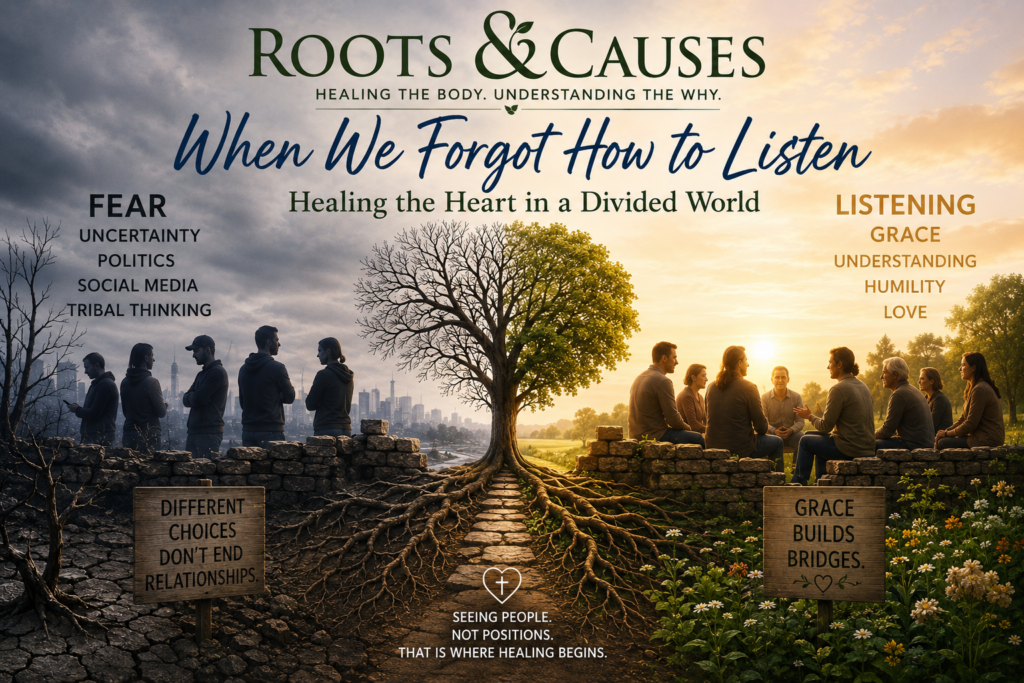
The real story is what happens when fear, uncertainty, politics, social media, and tribal thinking cause us to stop seeing the humanity in one another. That is the wound I believe many people are still carrying. Families stopped talking. Friends walked away. Churches became divided. Coworkers avoided one another and neighbors became strangers.
Some relationships have never recovered. THAT should matter to every one of us.
When We Started Choosing Teams
One of the saddest things I watched happen was how quickly people began choosing teams. If someone agreed with us, they were “our people.” If they disagreed, they became “the other side.”
But people are not teams! They are human beings, they are mothers, fathers, grandparents, brothers, sisters, friends.
They are children of God.
Every person carries a story we may never fully understand; they have fears, they have lived experiences that shaped how they make decisions.
Every person deserves dignity, even when we disagree.
Different Choices Don’t Always Come From Bad Intentions
One lesson life has taught me is this:
People can look at the same situation and honestly come to different conclusions. Sometimes those conclusions are based on personal experiences and sometimes on conversations with trusted healthcare professionals. Or maybe on faith, family history, or how they interpret and UNDERSTAND the information in front of them.
That doesn’t automatically make one person good and another person bad. We should be careful about assigning motives to people we don’t truly know their WHY. Most people are simply trying to protect the people they love.
Even when they disagree about how to do it.
We Need to Learn to Think Again
One of the greatest gifts God gave us is the ability to THINK. To be able to reason, ask questions, seek wisdom, pray, learn….
None of us should blindly believe everything we hear.
Not on television.
Not on social media.
Not from politicians.
Not from influencers.
Not even from me.
I hope people read my articles, but I also hope they ask questions. That they READ, learn, pray, and discern for THEMSELVES.
Talk with trusted healthcare professionals, search the Scriptures, think critically.
True wisdom grows when we remain teachable.
Social Media Was Never Meant to Replace Real Relationships
Social media has given us wonderful opportunities to stay connected. It has also created challenges.
The loudest voices often receive the most attention, strong emotions spread faster than quiet conversations, and arguments are rewarded more than understanding. It becomes easy to reduce another human being to a profile picture and a comment. But real life isn’t designed to work that way. Real healing happens face to face. it happens in conversation across a dinner table, during a walk, over a cup of coffee, or on a front porch.
The internet may connect us, but relationships are built through real conversations.
There Is Wisdom in Every Generation
I sometimes hear people dismiss older generations by saying, “They don’t understand.” And maybe sometimes they don’t. Older generations have lived through things many younger people have never experienced. They’ve seen wars. Economic hardship. National tragedies.
Loss.
Recovery.
They’ve learned lessons that cannot be found in a textbook. At the same time, younger generations often bring fresh ideas, creativity, and new ways of solving problems. Neither generation has all the answers. We need one another.
Wisdom grows when experience and fresh perspective sit at the same table.
Healing Begins With Personal Responsibility
One thing I have learned in healthcare is that healing always involves personal responsibility. We cannot control what other people believe, or decisions they make. We cannot control every opinion we hear, but we are responsible for how we respond.
We choose whether we show kindness.
We choose whether we listen.
We choose whether we forgive.
We choose whether we STAY ANGRY.
We choose whether we let bitterness take root, no one else can make those choices for us.
What If We Asked Better Questions?
Instead of asking, “Who was right?” Maybe we should ask, “What did we learn from all of this?” Instead of asking, “How do I win this argument or how do I change their mind?” Maybe ask, “How do I protect this relationship?”
Instead of asking, “How do I prove my point?” Maybe ask, “What is this person afraid of?”
Those questions open doors. Arguments only CLOSE them.
Healing Relationships Is Good for the Body
At Tea of Life Apothecary and SA Integrative Health, we often talk about healing the body. But healing isn’t only physical. Chronic stress affects the body. So does bitterness, loneliness, constant conflict, DISCONNECT, and living in a state of anger. Many people believe they are doing what is “healthy” by disconnecting from what they have deemed “toxic people”…. You have only built your OWN disease prison.
Living in a state of anger affects the body. This doesn’t mean every illness comes from emotions. It simply means our emotional health and physical health are connected. Sometimes one of the healthiest things we can do is lay down a burden we’ve been carrying for years.
Grace Is Stronger Than Agreement
One of the greatest misunderstandings in today’s world is believing that agreement is required before love can exist.
It isn’t.
You can disagree with someone and still respect them. You can vote differently and still be friends, you can make different healthcare decisions and still love one another, and you can hold different opinions and still socialize.
Grace doesn’t require agreement.
Grace simply says, “I still see your humanity.”
What Can You Do Today?
Maybe healing begins with something simple. Call someone you’ve been avoiding, write an email. Invite someone to coffee.
Ask questions instead of making assumptions. Spend less time arguing online, and more time talking in person. Aim to listen more than you speak. Pray before you react.
Show the same grace you hope others will show you.
A Biblical Reminder
One of my favorite verses is found in Romans 12:18:
“If possible, so far as it depends on you, live peaceably with all.”
Notice what it doesn’t say.
It doesn’t say everyone will agree or that everyone will apologize. It doesn’t say everyone will think the same.
It simply reminds us that we are responsible for our part. Sometimes peace begins with one person choosing humility. Maybe that person is us.
The Bottom Line
Healing isn’t just about the body. It’s about the heart and relationships. It’s about learning to see people again instead of positions.
The world has changed.
Some of those changes are permanent.
But we still have a choice. We can continue building walls, or we can begin building bridges. We can stay committed to winning every argument, or we can become committed to understanding one another. The future will always bring new challenges.
My prayer is that the next time fear, uncertainty, or division enters our lives, we remember something we almost forgot:
The person sitting across from us is never simply an opinion. They are a fellow human being that was created in the image of God. They are worthy of dignity, kindness, of being heard (even if we DISAGREE) just as WE ARE.
And perhaps…
That is where healing truly begins.
A Final Thought
This article isn’t asking you to change your political views, your medical decisions, or your deeply held beliefs. It is asking something much simpler—and perhaps much harder.
To choose grace over pride. To choose curiosity over assumptions and conversations over arguments. To choose people over positions.
Because healing doesn’t begin when everyone agrees, it begins when we remember how to love one another, even when we don’t.